Have you ever watched a movie and felt completely swept away, only to wonder how the director pulled it off? You're not alone. That magic isn't accidental. It's the result of deliberate choices, structural frameworks, and a deep understanding of human psychology. This is where film theory comes in. Far from being just dry academic jargon reserved for film school classrooms, film theory is a highly practical toolkit for creators of all kinds.
Today, the line between visual and written storytelling is practically gone. Creative writers, novelists, and poets are increasingly turning to film theory to elevate their prose.¹ Why? Because modern audiences are highly visual. Having grown up surrounded by screens, your readers naturally translate written words into a movie in their minds.¹ By understanding the mechanics of how cinema builds meaning, you can write stories that are more immersive, propulsive, and emotionally resonant.
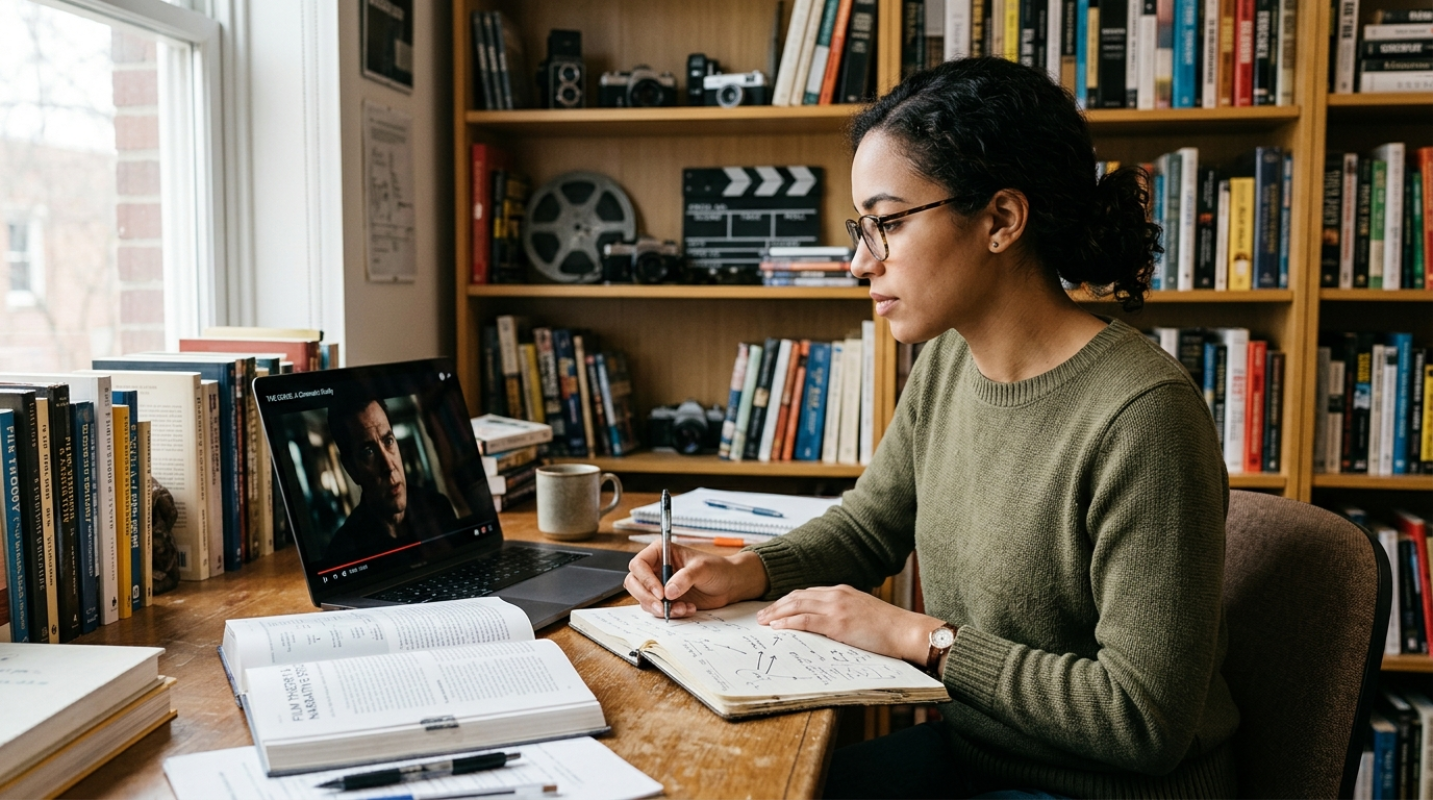
Studying film theory shifts your relationship with media. You stop being a passive viewer who simply reacts to a story. Instead, you become an active analyst who understands why a scene makes you cry, laugh, or jump out of your seat. Once you grasp these cinematic mechanics, you can apply them directly to your own writing to give you complete control over your reader's imagination.
Deconstructing Narrative Structure in Film
Screenplays are masterclasses in structural discipline. A screenwriter must deliver a complete, emotionally satisfying story arc in a highly compressed timeframe, usually between 90 and 120 minutes. This level of structural rigor is incredibly beneficial for novelists. Applying screenwriting's tight three-act structure to a novel helps prevent the dreaded middle-book sag that ruins many manuscripts. It forces you to make sure that every single scene has a clear narrative objective.
But studying film theory isn't about blindly copying a formula. It's about understanding the origins of these structures so you can play with them. When you analyze how pacing, beats, and character arcs function visually, you learn how to manipulate time. You learn when to let a scene breathe and when to cut it short to keep the momentum going.
Once you master these visual pacing rules, you gain the freedom to break them. You can subvert traditional three-act structures because you actually understand why they were built in the first place. You can stretch out a moment of tension or compress years of backstory into a single, flowing transition, and make your prose feel incredibly dynamic.
The Psychology of Visual Language
How does a director make you feel uneasy before a character even speaks? They do it by tapping into the psychology of visual language. Cognitive film theory examines how the human brain processes visual and narrative cues. For creative writers, this theory explains exactly how a reader engages with your text.
Art historian and author Dr. Noah Charney explains that since the middle of the last century, readers have subconsciously translated written prose into moving images.² Legendary story instructor Robert McKee also pointed out that the human brain naturally stores its own experiences, storing real-life memories and fictional stories in the exact same neural location.³ Cognitive film theory, updated in recent textbooks like David Bordwell's Film Art, helps you understand how to feed the brain the precise sensory cues it needs to make a fictional world feel indistinguishable from reality.
You can easily translate these cinematic techniques into your writing process
• Soviet Montage and the Kuleshov Effect: This theory proves that viewers derive more meaning from the interaction of two sequential shots than from a single shot in isolation. Instead of writing that a character is terrified, you can use prose montage. Write about a pencil snapping, followed by the aggressive ticking of a clock, followed by a bead of sweat hitting the desk. Your reader's brain automatically connects these images to calculate extreme anxiety.
• Mise-en-Scène and Sensory Framing: Mise-en-scène refers to everything that appears before the camera, including props, lighting, and spatial arrangement. Novelist Peter Malone Elliott teaches writers to use camera angles in prose to control focus.⁴ You can use close-ups to capture micro-expressions and internal tension, like a trembling hand. You can use wide shots to establish a character's isolation within an environment. Or you can use tracking shots to guide the reader's eye dynamically through a crowded room instead of dumping static description.
• Non-Diegetic Pacing: In film, diegetic elements exist inside the story world, like dialogue or a radio playing in a room. Non-diegetic elements exist outside it, like the musical score. Professional book editor Alyssa Matesic advises novelists to manipulate these elements to control the atmosphere. You can use your prose style, such as altering sentence lengths and rhythmic syntax, to act as an invisible soundtrack that speeds up or slows down the reader's heart rate.
Genre Tropes and Audience Expectations
We all know the classic clichés. The detective who's one day away from retirement. The group of teenagers decides to split up in a dark forest. Film theory helps you identify these tropes and, more importantly, understand why they exist. By studying the history of genre, you can create a much more authentic voice and avoid lazy writing.
When you understand genre conventions deeply, you can use your reader's familiarity to your advantage. You can build suspense by playing into their expectations, or you can deliver incredibly satisfying payoffs by subverting them.
Horror film theory is a perfect example of this tension management. Educators have highlighted how films like Hereditary and The Babadook manage tension by using anticipatory scenes.⁵ These are scenes where absolutely nothing happens, but the entire focus is on the anticipation of a threat. By studying this, you learn how to stretch out the space between a setup and a payoff, so your eventual climax feels earned and incredibly impactful.
Applying Cinematic Techniques to Your Writing Process
So, how do you take these academic concepts and use them at your writing desk? You can start by physically scripting your scenes. Before you write a heavy block of narrative text, try outlining it as a series of camera shots. Ask yourself what the camera is looking at. Is it a tight close-up on a character's eyes? Is it a panning shot of a messy kitchen? This exercise forces you to focus on action and movement, which instantly improves the flow of your prose.
You can also use montage theory to handle transitions and time-skips. Instead of writing a boring, expository paragraph about a character's long journey, use a quick sequence of vivid, contrasting images to show the passage of time.
Finally, develop a director's eye when you edit your own drafts. When you review your manuscript, don't just look for grammatical errors. Look at the framing. Are your descriptions too static? Are you telling the reader how to feel instead of showing them the visual cues? Cut the fluff, tighten the angles, and make sure every single image on the page deserves its screen time.
If you want to dive deeper into this intersection of cinema and writing, here are a few excellent resources to explore.
The Modern Storyteller's Advantage
The bridge between film theory and creative writing has become highly formalized. Recently, in 2025, the Poetry School ran a course exploring how poets can use cinematic techniques like jump cuts and montages to sharpen poetic imagery. Prestigious institutions have also launched hybrid programs. The University of Oxford offers a course called Thinking in Frames, while other universities offer dedicated degrees in creative writing and film.
Developing visual literacy gives you a massive advantage as a modern writer. It helps you bridge the gap between different media, which is incredibly useful since Hollywood managers and producers actively scout cinematic prose competitions for highly adaptable stories.
The next time you watch a movie, don't just turn your brain off. Watch it with a director's eye. Pay attention to how the camera moves, how the sound builds, and how the scenes transition. Great stories are built on the foundation of understanding how we perceive them, and film theory gives you the perfect map to handle that world.
Sources:
1. Reedsy - Writing Cinematically
https://reedsy.com/live/writing-cinematically/
2. YouTube - Noah Charney Masterclass
https://www.youtube.com/watch?v=5VmRYwu4Was
3. The Story - Four Storytelling Tips from Robert McKee
https://thestory.au/articles/four-storytelling-tips-from-robert-mckee/
4. Blue Pencil Agency - How Film Techniques Can Improve Your Writing
https://bluepencilagency.com/how-film-techniques-can-improve-your-writing/
5. Scream Horror Magazine - Tap the Power of Horror Film to Transform Creative Writing
https://www.screamhorrormag.com/beyond-the-syllabus-tap-the-power-of-horror-film-to-transform-creative-writing-teaching/
 .jpeg)