.jpeg)
Think about the last time you played a game that made your hands sweat and your heart race. Was it just the high-end graphics on your screen? Or was it that low, pulsing cello that started playing right before things went wrong?
Music in video games is the invisible force that pulls you in and refuses to let go. It's not just background noise to keep your ears busy while you press buttons. It's a highly sophisticated psychological tool designed to influence your choices and keep you completely locked into the experience.
The Invisible Architect and Why Game Music Defines Your Experience
Let's look at the numbers because they show just how serious this industry has become. The global video game music market is a massive business, valued at 1.38 billion dollars in 2024 and projected to reach 2.39 billion by 2032.¹ AAA game studios are not treating audio as an afterthought anymore.
In fact, major studios now spend up to 15% of their entire production budgets purely on sound and music. Why are they spending so much? Because it works.
Data shows that a truly immersive, adaptive soundtrack can increase your playtime by 20% to 30%. When the music reacts directly to your actions, you stay in the zone longer.
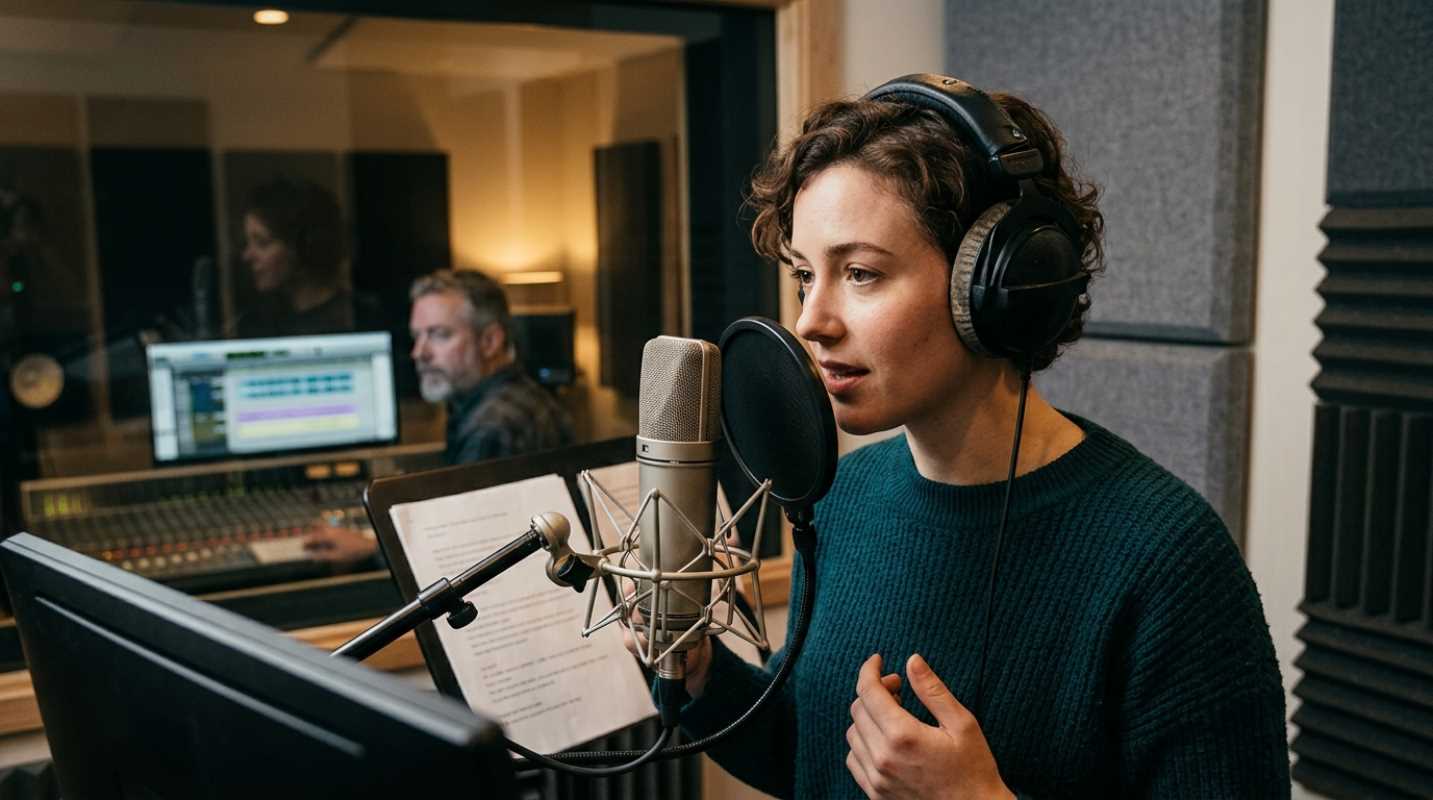
Game composers act as co-storytellers. They don't just write a pretty tune that loops in the background. They build sonic systems that guide your emotions, warn you of incoming danger, and celebrate your victories in real time.
Inside the Composer Process from Concept to Console
Writing music for a game is completely different from writing a film score. Think of a film score as a straight line. The composer knows exactly when the hero will jump, when the car will crash, and when the credits will roll.
But in a game, you are in control. The composer has no idea when you will turn a corner, start a fight, or just stand still and look at the scenery.
This is why composers have to think differently. Wilbert Roget, II, the composer behind Helldivers 2 and Star Wars Outlaws, describes film scoring as arithmetic because everything is locked in place. He says game scoring is more like algebra because you have unknown variables (the player's unpredictable choices) and you must write music that solves for those variables in real time.¹⁰
To do this, composers build motifs, which are short musical ideas that represent specific characters, places, or moods. Look at Borislav Slavov's work on Baldur's Gate 3. He built almost the entire score around a single, simple melody called "Down By the River".
This melody changes constantly depending on what you are doing. It sounds like a quiet acoustic song when you are creating your character, turns into a tense orchestral march during a tough battle, and becomes a tragic vocal piece when things go wrong. Slavov even used a small, highly personal choir instead of a massive Hollywood chorus to make the music feel intimate and unsettling.
Slavov wanted the soundtrack to feel like a living companion on your journey. By using the same melody in different tempos, keys, and arrangements, he created a sense of familiarity that grounds you in the world. It's the musical equivalent of a comfort blanket that occasionally turns into a battle shield.
Other composers take a highly experimental approach to match the game's atmosphere. Petri Alanko, who scored Alan Wake 2, treats horror music like a psychological experiment. His motto is "not a loop, a spiral." He wants the music to feel like it is constantly closing in on you, slowly building tension without ever giving you a chance to breathe.
To capture the terrifying vibe of the game's Dark Place, he didn't just sit at a piano. He used over 2,000 plugins and custom instruments. His recording sessions included
• Rusty metal: He recorded the acoustic resonance of a rusty cattle fence.
• Fire and wood: He burned two actual pianos to record the wood cracking under the heat.
• Violent impacts: He dropped a piano from a forklift onto a concrete floor to get a brutal, organic impact sound.
• Horror textures: He used a custom instrument called the Apprehension Engine to create metallic, scraping sounds.
The Mechanics of Interactive Music Design
So how does this music actually change while you play? It comes down to two main techniques that sound complicated but are incredibly elegant in practice.
The first is called vertical remixing, which is also known as layering. Imagine a song split into different instrument tracks (stems) like drums, bass, guitar, and brass. All of these play at the exact same speed and in the same key.
When you are just walking through an empty forest, you might only hear a quiet acoustic guitar. But the moment an enemy spots you, the game engine automatically fades in the drums. If a giant boss appears, the heavy brass tracks slide in. The song doesn't change, but its intensity scales up or down based on what is happening on screen.
The second technique is horizontal re-sequencing. This is where the composer cuts a piece of music into separate blocks (or cues). The game engine rearranges these blocks on the fly based on your choices.
The biggest challenge here is making sure the transitions don't sound terrible. If you suddenly run away from a fight, the music can't just cut off mid-note. Systems are designed to wait for a natural musical pause (like the end of a two-bar phrase) before transitioning to the next cue, keeping you in that perfect flow state.
Then there is the sheer scale of modern games. Woody Jackson, who composed the music for Red Dead Redemption 2, had to deliver over 40 hours of music.
To prevent your ears from getting tired of the same loops over dozens of hours, Jackson recorded 15-minute continuous jam sessions with live musicians. He told them to play with very low, supportive energy. The audio team then chopped these long sessions into modular pieces that the game engine could randomly mix together, meaning you almost never hear the exact same musical combination twice.
Technological Evolution and How Modern Tools Are Changing the Game
None of this would be possible without the incredible tech running under the hood. In the past, composers had to hand off their music to programmers and hope for the best. Today, they use specialized audio middleware like Wwise and FMOD to design how the music behaves inside the game.
We are also seeing a massive shift toward procedural and generative music. Instead of playing back recorded audio files, game engines are starting to generate music note-by-note in real time. Unreal Engine 5 uses a system called MetaSounds, which lets composers build audio systems that react directly to physics, player speed, or weather.
There's also Reactional Music, an engine that lets commercial music tracks change dynamically to match gameplay actions. Reactional Music is changing how we think about licensed music.
Historically, licensed soundtracks like the radio stations in Grand Theft Auto were completely static. You listened to a song, and it played from start to finish regardless of whether you were driving calmly or escaping a five-star police chase. This new engine changes that by slicing up mainstream tracks on the fly so they hit their crescendos exactly when you hit a jump.
Think about what this means for the future. In-game personalization is a massive market, expected to hit 100 billion dollars by 2029. Soon, you might be able to buy your favorite real-world songs as DLC, and the game will automatically slice and adapt those tracks to react to your sword swings or car drifts in real time.
Even touch is getting involved. Meta Haptics Studio now integrates directly with FMOD and Wwise.⁹ This means sound designers can automatically turn audio frequencies and rhythms into physical vibrations in your controller, connecting what you see, hear, and feel into one unified experience.
If you want to experience some of the best interactive soundtracks on the market today, here are a few titles that represent the absolute peak of modern game audio design.
The Lasting Power of Great Game Music
Why does all of this matter? Because music is the emotional glue of the entire gaming experience.
Years after you put down the controller, you might forget the exact plot of a game or the layout of a level. But the moment you hear those first few notes of the theme song, the memories come rushing back.
Great game music is a major pillar of a game's cultural legacy and commercial success. It turns a collection of pixels and code into a living, breathing world that feels intensely personal to you.
As technology continues to evolve, the line between playing a game and conducting its soundtrack will only get thinner. The next time you load up your favorite game, take a second to just listen. You're not just playing a game, you're playing an instrument.
Sources:
1. Global Video Game Music Forecast Market
https://www.24marketreports.com/consumer-goods-and-services/global-video-game-music-forecast-market
2. Meta Haptics Studio Meets FMOD and Wwise
https://developers.meta.com/horizon/blog/meta-haptics-studio-meets-fmod-wwise/
3. Star Wars Outlaws and Helldivers 2 Composer Wilbert Roget II Interview
https://fandomwire.com/star-wars-outlaws-and-helldivers-2s-composer-wilbert-roget-ii-explains-the-difference-in-his-approach-gundam-requiem-for-vengeance-and-his-perfect-score-interview/