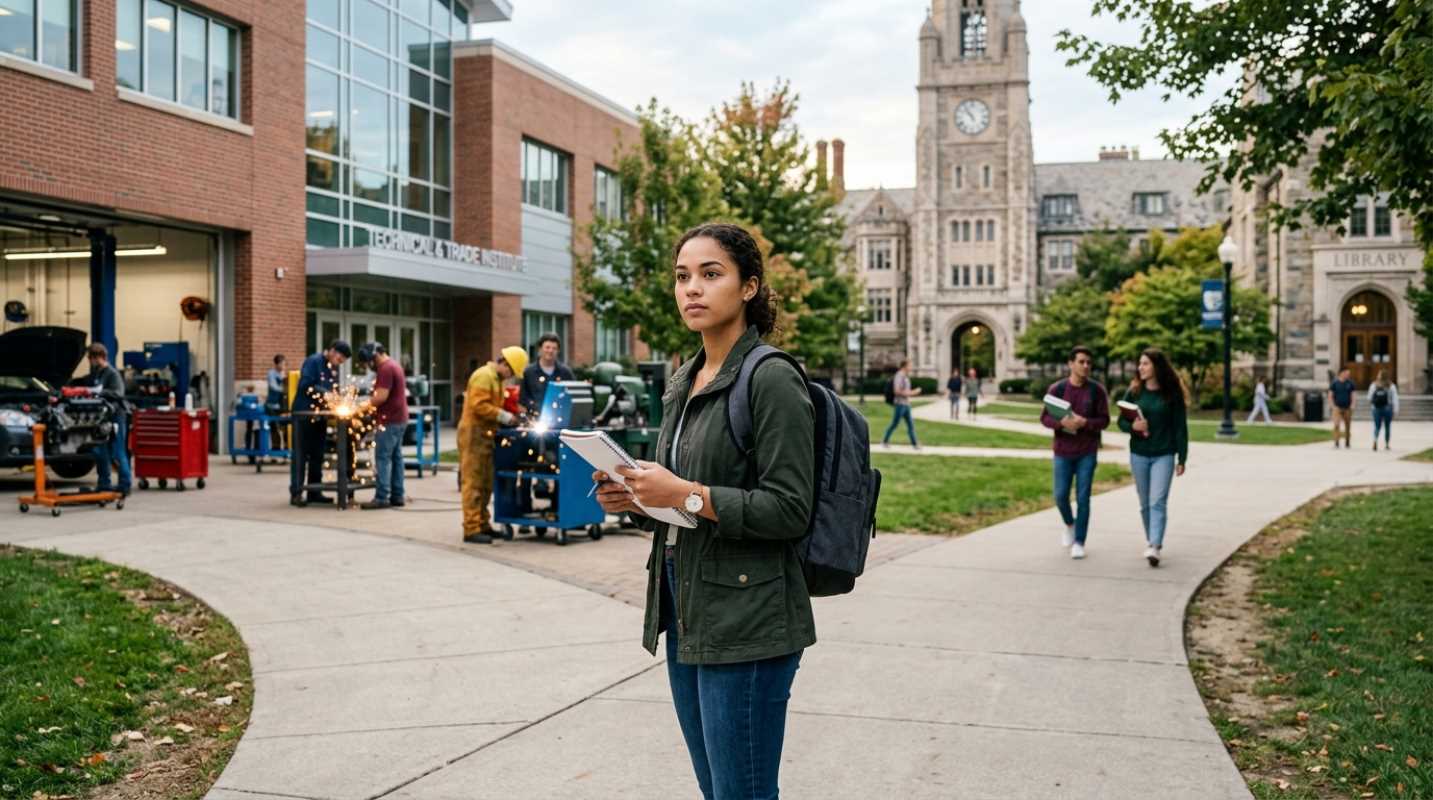
Remember sitting in a high school assembly while a counselor told you that a four-year degree was your only ticket to a good life? For decades, that was the standard script. But in 2026, that script is getting a major rewrite.
With student debt reaching eye-watering levels and artificial intelligence shaking up white-collar jobs, people are asking hard questions about the value of a university degree. Trade schools are no longer viewed as a backup plan. They are a highly competitive, fast-track route to financial independence.
So how do you decide which path is right for you? There is no single correct answer here. The goal is to align your education with your personal strengths and life goals, rather than trying to satisfy someone else's expectations.
The Great Education Debate
The cultural perception around vocational training has shifted dramatically over the last few years. A study by Skillit found that 60% of Americans now believe trade skills are more valuable than a college degree for securing a stable, high-paying job.
People are looking at the realities of the modern workforce and realizing that a university degree is no longer the golden ticket it used to be. In fact, roughly 42% of college graduates are currently underemployed, working in jobs that do not even require a degree.
At the same time, we are seeing a massive shortage of skilled physical labor. The old narrative that you must get a desk job to be successful is crumbling. Today, success is about finding a viable, high-demand niche and mastering it.
The Case for Skills-Based Training
Let's look at the trade school route first. If you hate the idea of sitting in a lecture hall for hours listening to abstract theories, this is where you want to look. Trade schools focus entirely on hands-on, practical learning.
You learn by doing. Whether you are learning how to wire a smart-home system, weld structural steel, or write clean code at a bootcamp, you are building tangible skills from day one.
The speed of these programs is a massive advantage. Most trade programs take anywhere from six months to two years to complete. This means you get to leap into the workforce and start earning a real paycheck while your university peers are still buying expensive textbooks.
Plus, the demand for these skills is through the roof. The U.S. is facing a massive shortage of skilled labor as older workers retire. Think about these high-demand industries
• HVAC and Smart Systems: Specialized technicians are needed to keep modern, energy-efficient buildings running.
• Electrical Work: The country is projected to face a shortage of 300,000 electricians over the next decade.
• Wind Turbine Technology: This field is projected to see a staggering 50% job growth rate through 2034.
Perhaps the biggest advantage of physical trades in 2026 is their resistance to technological disruption. Although white-collar office environments face job cuts due to AI automation, physical trades require on-site human judgment, manual dexterity, and a physical presence. You cannot download a plumber to fix a burst pipe.
The Value Proposition of a Traditional Four-Year Degree
On the flip side, the traditional university path has its own unique strengths. A four-year degree is about more than just preparing for a specific job. It provides a broad academic foundation that teaches you how to think importantly, write persuasively, and analyze complex problems.
These soft skills are incredibly valuable. They give you the flexibility to pivot between industries as the economy changes.
For many corporate environments, a bachelor's degree is an needed passport. If your goal is to climb the ladder into executive leadership, manage large corporate teams, or enter fields like medicine, law, or engineering, a degree is non-negotiable.
We also cannot ignore the social aspect of college. The networking opportunities, campus organizations, and lifelong friendships you build at a university can open doors for decades to come. It is an environment designed to help you grow up, build a professional network, and figure out who you are.
Crunching the Numbers
Let's talk about the money. This is where the decision gets highly practical.
The starting cost of these two paths is wildly different. A typical trade school program costs between $20,000 and $33,000 total.¹ A four-year degree at a public university averages between $120,000 and $140,000, and that is before you factor in room, board, and interest.
This price difference translates directly into student debt. Although the average trade school graduate leaves with about $10,000 in debt, university graduates who borrow end up carrying between $36,327 and $43,333.
Then there is the hidden factor of opportunity cost. If you spend four or five years in college, you are missing out on years of full-time wages. A trade school graduate who enters the workforce three years earlier, even at a modest $30,000 starting wage, gets a $120,000 head start in lifetime wealth accumulation.³
So what does this mean for your return on investment?
• The 10-Year Outlook: Trade school wins the short-term race. Because trade graduates avoid heavy debt and start earning immediately, they break even within two years. They achieve a median 10-year ROI of $313,000, compared to just $160,000 for bachelor's degrees.²
• The 40-Year Outlook: College wins the long game. Over a 40-year career, the compounding wage premium of a bachelor's degree catches up. The median 40-year ROI for a public university degree is nearly $1.8 million, while a public certificate or associate program sits at $1.37 million.
• The Middle Ground: Do not let the averages fool you. Nearly 47% of skilled trades workers now earn more than the median college graduate. If you get a mid-range college degree in a field with low demand, you might end up earning less than a specialized plumber or electrician over your lifetime.
Finding Your Fit
Choosing between these paths requires some honest self-reflection. To find your best fit, grab a cup of coffee and ask yourself these three important questions.
First, how do you actually like to learn? Do you thrive in a classroom setting, reading books and writing research papers? Or do you get energized by tactile, physical work where you can see the results of your labor at the end of the day?
Second, what is your comfort level with debt? Are you willing to take on significant financial risk in exchange for a shot at a higher-paying corporate job later? Or would you prefer to start your adult life with a clean financial slate?
Third, what are your long-term career goals? Do you want to build a business of your own, like an electrical contracting firm? Or do you see yourself working in a creative agency or corporate office?
Owning Your Future
At the end of the day, neither path is inherently better than the other. Success is not about the piece of paper you hold. It is about how you execute your plan.
The modern economy values competence and adaptability above all else. Whether you choose to master a trade or earn a university degree, your willingness to keep learning will determine your long-term success.
Take a look at your budget, your learning style, and your career goals. Make a confident, data-driven choice, and do not look back. Your future is yours to build.
Sources:
1. Ayers Career College Blog
https://ayers.edu/blog/choosing-trade-school-over-college/
2. Austin Career Institute Blog
https://austincareerinstitute.edu/blog/trade-school/trade-schools-offer-better-roi/
3. Philadelphia Technician Training Institute Blog
https://ptt.edu/the-448000-difference-trade-school-roi-vs-bachelors-degrees-for-faster-wealth-in-2026/
*This article on localplan is for informational and educational purposes only. Readers are encouraged to consult qualified professionals and verify details with official sources before making decisions. This content does not constitute professional advice.*